
#



Seeing someone look at what they’ve made and think “I actually made that!” is one of my favourite moments in teaching. Lou had that moment in my studio, and she told me it followed her all the way home to Ireland.
Before that moment, though, she had a decision to make. She researched a number of trainers, compared what each one offered and had to work out who to trust with something this meaningful. If you’re comparing your options for a life casting course, here’s what’s actually worth looking at, based on her experience and the questions people ask me most.
1. Is the Trainer Still Doing the Work?
Start with this: is the person teaching you still working with real clients? Materials change, techniques move on, and real families bring situations that don’t sit neatly in a set of course notes. I still create pieces for real families, so what I teach you is what I’m doing this month, not what I did years ago.
2. How Much of the Day Will Actually Be Yours?
Lou had already looked into several trainers before she found me:
“I had researched a number of trainers beforehand and contacted others too. Some were very expensive and some felt quite fixed in their approach, where you almost had to fit your business around the way they worked.”
Ask how many students share the trainer’s time, and how much of the day is genuinely yours. My training is always 1:1, so the pace is yours. If something needs explaining twice, we explain it twice.
3. Why Working With Real Babies, Families or Pets Matters
This one’s worth slowing down on, because it’s easy to underestimate.
A doll doesn’t wriggle, and a practice board doesn’t sneeze. A real baby has no idea you have a lesson plan. Working with a real model teaches you things no amount of watching can: how to read a baby who’s about to get upset, how to keep a nervous parent calm while you work, how to adjust in the moment when something isn’t going the way it did in the demonstration. Watching someone experienced do something is very different from doing it yourself. That’s not a small detail. It’s the actual job.
Ask whether you’ll work with real babies, families or pets, and whether that’s included in the price. I arrange real models at no extra cost, where appropriate, because I want you to leave knowing what it’s actually like, not just what it looks like when someone experienced does it.
4. Will the Course Adapt to You?
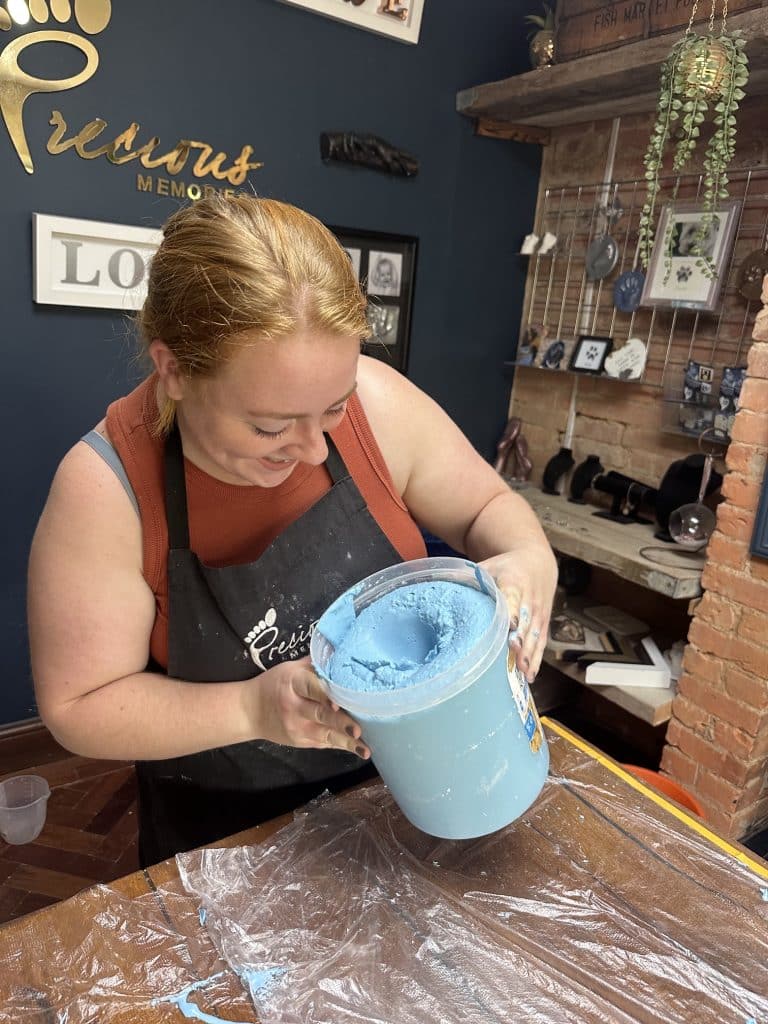
When Lou first rang me, she was thinking of coming for seven days. I advised against it. There’s only so much anyone takes in at once, and I’d rather a student go home confident in what matters most than try to absorb everything in one go. We settled on five days in total: three for the Lifecasting Masterclass, and two for jewellery training later.
That conversation mattered to her:
“Glenda took the time to listen to me, my previous experience, my business and what I actually wanted to achieve. She didn’t just give me a set way of doing things and expect me to follow it. She explained the why behind what we were doing and adapted the training around what I needed.”
5. Will the Trainer Understand Where You Are in Life?
I train people at very different points in their lives, and what brings them here is rarely their age. It’s usually the moment they’re in.
New mums often come looking for something creative that fits around a baby rather than a nine-to-five. Others arrive once their children have grown up and left home, wanting a new direction now that their days look different. A career change, often after redundancy or simply deciding it’s time for something else, brings just as many people through the door.
None of those are the wrong reason to train. They’re the reasons I hear most often, and every one of them is a genuine, good reason to be here.
6. Does the Course Teach Finishing, Not Just Casting?
Getting a good cast is only half the job. A beautiful cast can still be let down by a poor finish, and the finish is what a family actually sees on display in their home. Day 2 of my three-day hand casting course includes professional airbrush finishing, and there’s a separate Airbrush Masterclass for going further.
7. Ask What Happens When Something Goes Wrong
I want to be honest about this one, because it’s true: things sometimes go wrong. A cast doesn’t come out the way you expected. A finish doesn’t take. A client asks you something you don’t know how to answer. It happens to everyone, including me, and good training doesn’t pretend otherwise. What it should do is teach you how to handle it when it does.
There’s a real difference between “here’s your certificate, good luck” and “send me a message and we’ll work it out.” Lifetime WhatsApp and email support is included with my training. One student rang me nine years after her training, upset about a difficult client. We talked it through, more than once, until she felt ready to see the family again.
Lou put her own version of this simply:
“I went home knowing I have Glenda’s support and advice in running my business.”
8. Ask Whether You’ll Learn to Run a Business, Not Just Make Casts
This is worth asking directly, because it’s often assumed rather than taught. Making a good cast is a craft skill. Working out what to charge, how to talk to a nervous client, how to present your finished work, and how to actually get bookings once you’re home is a different skill entirely, and a course can teach the first without ever touching the second. Ask what happens to your questions once training ends, and whether pricing and client conversations are actually covered, or just mentioned in passing.
9. Compare What’s Included, Not Just the Price
Don’t just compare the total cost of a life casting course, compare what it includes: models, materials, a supplier list, and whether any support continues once you go home. A cheaper course that leaves you working everything out alone afterwards may cost more in time and confidence than a slightly higher price that includes it.
On my Hand Casting Course, Day 1 is £550, Day 2 is £550 and Day 3 is £650. Booking all three days together is £1,650, saving £100, which applies only to the three-day hand casting package. Whoever you train with, make sure you know exactly what a price covers before you pay a deposit.
10. Read Reviews — and Look Beyond the Finished Work
A high star rating tells you people were happy with the life casting course they chose. It doesn’t tell you why. Look for reviews that mention confidence, support and what happened after training, not just the star rating on its own.
And don’t judge a course solely by beautiful finished work. Being excellent at the craft and being able to teach it clearly are two different skills, and one doesn’t guarantee the other.
This is why speaking to someone before you book matters more than any photograph. Pick up the phone, ask your questions, and see how the conversation feels. Lou’s advice to anyone in her position was simple:
“I would absolutely recommend speaking to Glenda before choosing your training.”
I have 100+ reviews on TripAdvisor, rated 5.0, and 60+ on Google, rated 4.9. Precious Memories was named a Travellers’ Choice Award Winner in 2024 and 2025.

What Lou Took Home
Lou trained on my three-day Lifecasting Masterclass, working with baby and dog models. In her words:
“I came home absolutely buzzing and kept looking at the work I’d created thinking, ‘I actually made that!'”
The line I’m proudest of in her whole review is this one:
“What I really appreciated was that Glenda didn’t try to turn me into a copy of her. She helped me become better at being me and showed me how I could take these skills and make them work for my own business.”
She went home and began building Forever Held By Lou, creating bespoke and personal keepsakes for families alongside the hospice work that means so much to her. You can read her full review on TripAdvisor.
Frequently Asked Questions
Do I have to book all three days at once?
No. Book one, two or three days, and take Day 3 later once you’ve had time to practise. The £100 saving applies when all three days are booked together, whatever dates you choose to attend them on.
Do I need to take notes during training?
There’s no need. You’ll go home with comprehensive notes, photos and short videos from the day, plus my supplier list with trade discount codes.
Can I keep what I make?
Everything you create during training is yours to take home.
What happens on the training day?
Training runs from 9:30am to 3:30pm with a short lunch break. I explain each stage as we go, so many questions get answered before you ask them.
Which airports are closest?
Bournemouth Airport is around 25 minutes from the studio by car, and Southampton Airport is around 50 minutes. Free parking is available at the studio.
How does booking work?
A 50% deposit secures your date, with the balance due the week before. International students can pay via Wise.
Is it worth travelling from abroad to train?
Students have travelled to me from Ireland, Norway, India, Tanzania, Germany, Cyprus, the USA and across the UK, and I can help with dates and accommodation guidance.
Ready to Talk It Through?
Whether you’re looking for a life casting course, memorial training or something more specialist, a conversation is the simplest next step. Tell me what you’d like to learn and what experience you already have, and I’ll help you work out the right training. There’s no obligation and no pressure.
WhatsApp Me · Email Me · Call for a Chat
Written by Glenda, who has taught lifecasting for more than 20 years and still creates pieces for real families.